What Is Bare Metal Hosting? Complete Guide
Picking the right hosting can feel like a minefield. Shared hosting, VPS, cloud, dedicated, bare metal — at some point, it all starts to blur together. If you’ve landed here wondering what bare metal hosting actually is and how it’s different from everything else, you’re not alone.
This post is going to clear that up for you. We’ll walk you through what bare metal hosting means, who it’s built for, and what makes it stand out — so by the end, you’ll know exactly whether it’s what your project needs.
What is Bare Metal Hosting?
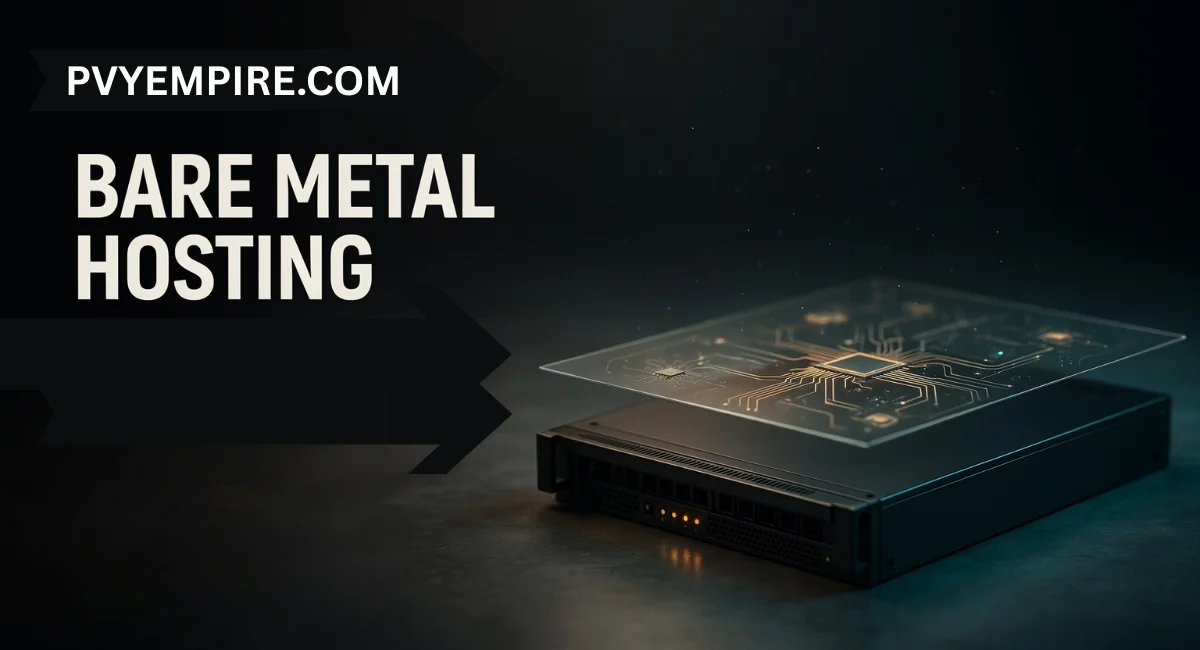
At its core, what is bare metal hosting comes down to one simple idea: you get an entire physical server all to yourself. There’s no hypervisor slicing up the hardware, no other tenants sharing the same machine, and no virtualization overhead eating into your resources.
Every CPU core, every byte of RAM, and every bit of storage belongs entirely to you.
Think of it like owning a house versus renting an apartment. In an apartment, you share the building’s plumbing and electrical systems with others. With bare metal, the whole house is yours. You can knock down walls, rewire the electrics, and paint every room however you like.
That kind of freedom is exactly what bare metal dedicated servers offer — and it’s why businesses with serious performance needs keep coming back to them.
Bare Metal Servers Explained
Bare metal hosting isn’t a new concept, but in 2026, it’s more relevant than ever. The rise of AI workloads, big data analytics, and mission-critical infrastructure has pushed demand for dedicated hardware through the roof.
In fact, the bare metal market is projected to hit $30 billion globally — and it’s not hard to see why. Modern applications simply can’t afford the performance gambles that come with shared cloud environments.
What’s changed in recent years is how fast you can get up and running. Automated provisioning means a fully configured bare metal server — complete with your chosen OS and network settings — can be ready in minutes rather than days.
Providers now offer on-demand bare metal with flexible billing, GPU-equipped servers for heavy compute tasks, and bare metal cloud integrations that blend dedicated hardware with cloud-style scalability. It’s the best of both worlds.
Why is it called “Bare Metal”?
The name “bare metal” is actually pretty literal. The server is “bare” because there’s no virtualization layer sitting between you and the hardware.
When you spin up a virtual machine on a cloud platform, your operating system talks to a hypervisor first — a software layer that manages access to the physical machine for multiple users. Bare metal cuts that middleman out completely.
Your operating system installs directly onto the physical hardware, just like installing Windows or Ubuntu on your own laptop. The result is lower network latency, faster I/O throughput, and more predictable performance.
There’s nothing in between your application and the raw computing power of the server. That direct, unfiltered access is what makes bare metal hosting fundamentally different from every other hosting type.
How Bare Metal Servers Actually Work
A bare metal server runs on the same type of hardware you’d find in any enterprise data center — latest-generation Intel or AMD processors, high-speed NVMe storage, and large amounts of RAM.
The key difference is that your operating system has a direct line to all of it. No hypervisor in the way, no shared resource pools, and no compute density trade-offs. You get the full machine, period.
Because there’s no virtualization layer to manage, the server behaves exactly like a physical machine you own outright. You install your OS, configure your firewall, set up your RAID configuration, and deploy your applications — all with full root access.
The hardware responds directly to your software, which is why bare metal consistently outperforms virtual environments for demanding workloads like databases, streaming, and real-time analytics.
From Days to Minutes: The Modern Provisioning Process
Not long ago, getting a bare metal server online was a slow, manual process. A technician had to physically rack the machine, cable it up, and install the OS by hand — sometimes taking days or even weeks.
Today, automated provisioning has completely changed that. Modern providers can deploy a fully configured server in just a few minutes.
The platform finds a matching machine, installs your chosen OS from a master image, handles all the network configuration, and hands you secure login credentials — all automatically.
You get the raw power of dedicated hardware with the on-demand speed you’d expect from the cloud.
Complete Control with Root and OOB Access
One of the biggest draws of bare metal is the level of control you get. Full root access means you can install any software, tweak the OS kernel, and fine-tune every setting to get maximum performance.
But what happens if a bad configuration locks you out, or the OS crashes entirely? That’s where out-of-band (OOB) management comes in.
OOB server access operates on a completely separate network, so you can power cycle the machine, access the console, reinstall the OS, and run hardware diagnostics — even if the primary network is down.
It’s your emergency backdoor, and for mission-critical infrastructure, it’s non-negotiable.
Benefits of Bare Metal Dedicated Servers
The benefits of bare metal hosting go beyond just raw speed. Because you’re the only tenant on the machine, you eliminate the noisy neighbor problem — that frustrating situation where another user’s resource-heavy workload slows yours down.
Your performance is consistent and predictable, day in and day out, regardless of what anyone else is doing.
Here’s a quick summary of the core advantages:
- Maximum performance — 100% of the server’s resources are dedicated to your workloads
- Full customization — install any OS, software stack, or configuration you need
- Enhanced security — physical isolation means no shared attack surface with other tenants
- Predictable performance — no virtualization tax eating into your compute power
- Server scalability — upgrade hardware as your business grows
- Compliance-ready — ideal for HIPAA hosting and PCI-DSS compliance requirements
Who needs a Bare Metal Server?
Bare metal isn’t the right fit for everyone — but for certain use cases, it’s the only sensible choice. If you’re running a high-traffic website, a large database, or any application where downtime or slowdowns directly cost you money, bare metal gives you the stability you need.
Developers who need full root access and a custom software environment will also find it far more flexible than managed cloud hosting. Businesses in regulated industries — healthcare IT, financial services, legal — benefit from the physical isolation that makes compliance hosting far easier to achieve.
And if you’re running AI/ML workloads, game servers, or real-time analytics, the direct hardware access bare metal provides simply can’t be matched by a virtual server.
Unlocking Peak Performance and Unbreakable Security
Performance and security are the two biggest reasons businesses choose bare metal over cloud or VPS hosting. On the performance side, removing the virtualization layer gives your applications a direct connection to the CPU, RAM, and NVMe storage.
This means faster I/O, lower latency, and no random slowdowns caused by shared infrastructure. For workloads that demand consistent speed — think high-frequency trading, large-scale databases, or video streaming platforms — that predictability is worth its weight in gold.
On the security side, single tenancy is a game-changer. In a virtualized environment, a vulnerability in the hypervisor could theoretically expose other tenants on the same physical machine.
With bare metal, that entire class of threats disappears. You’re physically isolated from every other customer, which makes it significantly easier to meet strict compliance standards and protect sensitive data.
How Direct Hardware Access Delivers Maximum Speed
Without a hypervisor in the way, every system call your application makes goes straight to the hardware.
This eliminates what’s often called the “virtualization tax” — the performance overhead that builds up every time a virtual machine has to route requests through a management layer.
For a high-frequency trading platform, even a single millisecond of extra latency can cost millions. For a large-scale database churning through terabytes of data, direct access to Gen 4 or Gen 5 NVMe storage means queries run faster and results come back sooner.
Real-time analytics engines benefit too — dedicated compute density means the processor is always focused entirely on your workload, not juggling requests from a dozen other virtual machines.
A Fortress of Solitude: The Security of Single-Tenancy
Physical isolation is one of Bare Metal’s strongest security arguments. Because no one else shares your hardware, the attack surface that exists in multi-tenant environments simply doesn’t apply to you.
This matters enormously for organizations that handle sensitive data. Healthcare providers need HIPAA hosting to protect patient records. Payment processors need PCI-DSS compliance to secure cardholder data.
Both requirements are far easier to meet when your server has zero shared infrastructure.
Pair that physical isolation with always-on DDoS mitigation — which inspects and filters malicious traffic before it ever reaches your server — and you’ve got a genuinely robust security posture that virtual hosting can’t replicate.
Real-World Use Cases for Bare Metal Servers
It’s one thing to list the benefits of bare metal — it’s another to see how they solve real problems. The value of dedicated hardware becomes clearest when you look at the specific workloads that depend on it every single day.
For these use cases, the performance trade-offs of shared infrastructure simply aren’t acceptable.
Whether it’s keeping a financial platform running at lightning speed or delivering a lag-free gaming experience to thousands of players, bare metal provides the unshakable foundation that mission-critical work demands. Let’s look at where it makes the biggest difference.
High-Traffic Databases and Big Data
Imagine a global financial trading platform handling thousands of transactions per second. At its core is a database that needs to ingest data, run complex calculations, and return results in microseconds.
In a virtualized setup, the I/O path to storage passes through a hypervisor — adding a layer of latency that’s simply unacceptable at that speed. Bare metal eliminates that bottleneck.
Direct access to high-speed NVMe storage means read/write operations happen as fast as the hardware allows.
For big data analytics workloads — where teams are crunching terabytes of information to extract real-time insights — full I/O throughput and compute density are the difference between useful data and stale results.
SaaS and E-commerce Platforms
SaaS platforms and e-commerce websites live and die by their user experience. A slow checkout page or a crashing app during a flash sale can wipe out hours of revenue in minutes.
On a shared server, a traffic spike can quickly overwhelm the allocated resources — and everyone on that machine suffers. Bare metal hosting means 100% of the server’s CPU and RAM are always available to your application.
Whether it’s a regular Tuesday or Black Friday, the experience stays fast and consistent. That predictability is what dedicated server hosting for high-traffic websites is all about — reliable performance when it matters most.
Online Gaming Communities
In online gaming, latency is the enemy. Even a small delay between a player’s input and the server’s response can ruin the experience — especially in competitive multiplayer games.
Game servers have to process player data, manage complex game states, and stream updates back to thousands of clients in real time. A shared virtual server introduces multiple points where lag can creep in.
Bare metal game server hosting removes those bottlenecks, delivering the raw processing power and low-latency network connection that smooth gameplay requires.
Add robust DDoS mitigation on top of that, and you’ve got a server that stays online and performs consistently, even under attack.
AI/ML and High-Performance Computing
Training AI and machine learning models is one of the most demanding workloads in computing. These jobs can run for days, consuming massive amounts of CPU and GPU resources the entire time.
Virtualization can eat up 20–30% of a server’s capacity just to run itself — and for AI workloads, that overhead directly translates to longer training times and slower iteration cycles.
Bare metal gives AI frameworks direct, unfiltered access to GPU servers and high-performance CPUs from Intel or AMD, maximizing computational efficiency.
For HPC (high-performance computing) workloads — scientific simulations, genomics research, climate modelling — that direct hardware access isn’t a luxury. It’s a requirement.
Use Cases for Bare Metal Dedicated Servers
Beyond the specific industries above, bare metal dedicated servers fit a wide range of scenarios. Here’s a quick reference for common use cases and what to prioritize for each:
| Use Case | Key Requirement | Bare Metal Advantage |
| E-commerce | Consistent speed under traffic spikes | 100% dedicated CPU/RAM |
| Video streaming | High bandwidth and low latency | Direct NVMe + network access |
| Game servers | Real-time processing, DDoS protection | Low-latency + physical isolation |
| AI/ML training | Max GPU and CPU throughput | No virtualization tax |
| Financial platforms | Microsecond response times | Direct hardware access |
| Healthcare IT | HIPAA compliance, data security | Single-tenant isolation |
| Big data analytics | Fast I/O on large datasets | Full NVMe throughput |
| SaaS platforms | Stable performance at scale | Dedicated resources, no noisy neighbors |
How to choose the right Bare Metal Server?
Choosing the right bare metal server starts with understanding your workload. If you’re running a database or analytics platform, prioritize fast NVMe storage and plenty of RAM.
For AI and GPU-heavy tasks, look for providers offering GPU servers with the latest Intel or AMD processors.
Consider your traffic levels too — higher bandwidth needs mean you should look closely at the provider’s network capacity and server uptime SLA.
Also, think about whether you want managed hosting (where the provider handles maintenance and support) or unmanaged (where you have full control but handle everything yourself).
Finally, make sure the provider offers OOB server access and remote hands services — because when something goes wrong at 3 am, you’ll be very glad you have both.
How to set up a Bare Metal Server?
Setting up a bare metal server is more straightforward than it used to be, especially with modern automated provisioning. Here’s a simple step-by-step overview to get you started:
- Step 1 — Choose your provider: Pick a reputable bare metal hosting provider with the hardware specs, data center locations, and support level you need.
- Step 2 — Select your configuration: Choose your CPU, RAM, storage type (SSD or NVMe), and bandwidth. Match these to your workload requirements.
- Step 3 — Install your OS: Most providers let you pick from popular options like Ubuntu, CentOS, or Windows Server. Many also support custom ISO installs.
- Step 4 — Secure your server: Set up firewall configuration rules, disable unused ports, create strong user credentials, and enable DDoS mitigation through your provider.
- Step 5 — Deploy your applications: Install your software stack and configure everything to your requirements. With full root access, there are no restrictions.
The whole process can take as little as a few minutes for the initial setup, with most of your time going into configuration and security hardening.
If you’re new to server management, many providers offer managed bare metal options where their team handles the heavy lifting.
Choosing the Right Bare Metal Provider
Not all bare metal providers are equal, and choosing the wrong one can cause headaches down the line.
Start by evaluating the hardware — look for the latest-generation CPUs (Intel or AMD), Gen 4/Gen 5 NVMe storage options, and flexible RAID configuration support.
Check the network too: a provider with multiple data center locations and strong peering arrangements will give you lower latency and better redundancy.
Always review their server uptime SLA and ask specifically about their DDoS mitigation capacity — you want to know their total Tbit/s capacity and whether protection is automatic or opt-in.
Support quality is just as important as hardware. Look for 24/7 expert support with a guaranteed response time, guaranteed OOB server access, and remote hands services at all their locations.
Also consider scalability — can you easily upgrade to a more powerful server as your business grows, or will you face a painful migration?
Providers like ColoCrossing offer enterprise-grade colocation and dedicated infrastructure across multiple US data centers, while newer entrants like Soraxus focus on fast deployment with always-on DDoS protection built in.
The right choice depends on your specific needs, budget, and how much management you want to handle yourself.
Conclusion
By now, the answer to what bare metal hosting is should be pretty clear. It’s dedicated, single-tenant physical hosting that gives you full control, maximum performance, and strong security — without the virtualization overhead that holds back shared environments.
Whether you’re running a high-traffic e-commerce site, training AI models, managing sensitive compliance data, or hosting a competitive game server, bare metal dedicated servers provide the reliability and raw power that demanding workloads require.
The key is matching the right server to the right use case. If performance consistency, physical isolation, and full resource control matter to your business, bare metal is worth every penny.
Take your time evaluating providers, look closely at hardware specs and support quality, and don’t overlook features like OOB access and DDoS mitigation. Get those decisions right, and you’ll have an infrastructure foundation that scales with your business for years to come.
FAQs
Is bare metal the same as a dedicated server?
Pretty much, yes. Both terms refer to a physical server dedicated entirely to one user with no virtualization. The term “bare metal” tends to imply a more modern, cloud-like experience with automated provisioning and API management, while “dedicated server” sometimes refers to the older manual setup approach.
How long does it take to deploy a bare metal server?
With modern automated provisioning, a fully configured bare metal server can be online in just a few minutes. The platform installs your OS, configures the network, and hands you credentials automatically — no waiting for a technician to do it manually.
What is the noisy neighbor problem in hosting?
The noisy neighbor problem occurs in shared or virtualized environments when one user’s resource-heavy workload consumes too much CPU, RAM, or bandwidth — slowing down everyone else on the same physical machine. Bare metal eliminates this completely because you’re the only tenant on the server.
Can I use bare metal with cloud services?
Absolutely. Many businesses use a hybrid cloud strategy — running core databases and performance-critical workloads on bare metal while using scalable cloud instances for web traffic or burst capacity. It’s a smart way to get stable, predictable performance where it counts and flexible scaling where you need it.
Is bare metal hosting good for small businesses?
It depends on the workload. For most small websites or simple applications, a VPS or managed cloud hosting is more cost-effective. However, if your small business runs resource-intensive applications, handles sensitive compliance data, or experiences heavy traffic, managed bare metal hosting can be a worthwhile investment — especially since costs have come down significantly in recent years.

Alex Bryant is the founder of PvyEmpire.com and a WordPress specialist with over 4 years of hands-on experience in web hosting, performance optimization, and website management. He has extensively tested top hosting providers by setting up real websites and monitoring their speed, uptime, and reliability.
At PvyEmpire.com, Alex publishes honest, data-driven reviews, detailed guides, and verified coupons & deals. His goal is to help website owners choose the right hosting, improve performance, and grow their online presence with confidence—based on real testing, not promotions.