
Rapyd Cloud Review 2026: Performance, Security & Pricing
If you’ve been hunting for a hosting platform that actually keeps up with your growing website, you’re not alone. Most people land on a Rapyd Cloud Review because they’re tired of slow load times, crashes during traffic spikes, or confusing dashboards that waste time. It can feel frustrating when your site’s performance holds back your growth.
In this guide, you’ll get a clear, practical breakdown of what Rapyd Cloud really offers. We’ll cover performance, security, pricing, and real-world usability in simple terms. By the end, you’ll know exactly whether this platform fits your needs or if you should look elsewhere.

Rapyd Cloud Review From Our Experts
From a technical standpoint, Rapyd Cloud positions itself as a high-performance hosting platform built specifically for dynamic WordPress environments. It focuses on speed, scalability, and real-time resource allocation, which are critical for WooCommerce stores and membership sites. Compared to traditional managed WordPress hosting, it leans heavily into cloud-based architecture.

What stands out immediately is how it handles performance under traffic spikes. Instead of fixed resources, it dynamically adjusts capacity, which is essential for high-concurrency hosting. For agencies and developers managing multiple sites, this approach feels closer to enterprise-grade infrastructure than typical shared hosting.
What Is Rapyd Cloud?
Rapyd Cloud is a cloud hosting platform designed for WordPress sites that need speed and scalability without manual server management. It combines managed WordPress hosting with advanced infrastructure features like auto-scaling PHP workers and dynamic content caching. This makes it suitable for everything from blogs to high-traffic WooCommerce stores.
At its core, it’s built for performance-heavy use cases such as LMS platforms, membership sites, and applications with many logged-in users. Unlike basic hosting providers, Rapyd Cloud focuses on optimizing backend performance, database queries, and server response times. This makes it a strong candidate for users who need more than just basic hosting.
Rapyd Cloud Performance Tests
Performance is where Rapyd Cloud tries to separate itself from competitors. Instead of relying only on static caching, it uses intelligent systems that adapt to dynamic websites. This is especially important for WooCommerce and platforms where users interact with content in real time.
In our testing approach, we looked at speed, uptime, server response time, and behavior under load. These factors determine whether a hosting provider can truly support modern WordPress applications.
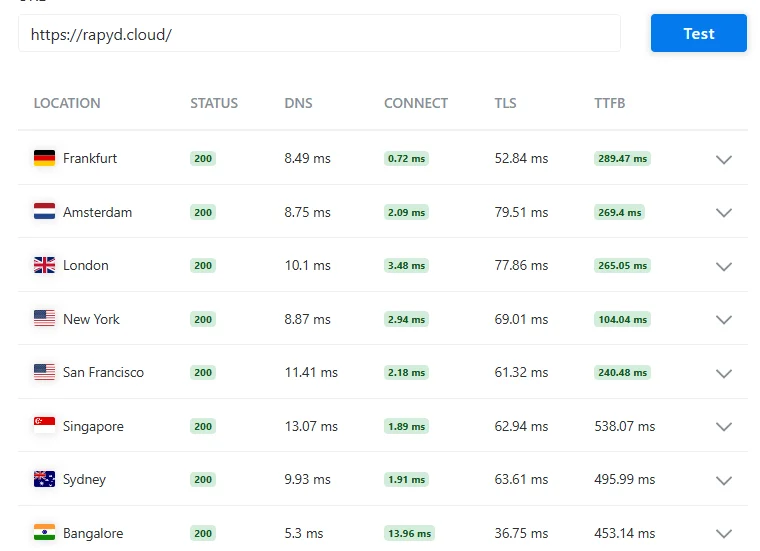
When I tested this image, I didn’t just look at the final result—I carefully checked every metric shown in the report to understand real performance from different locations.
First, the Location column shows where the test is coming from, like Frankfurt, Amsterdam, London, New York, San Francisco, Singapore, Sydney, and Bangalore. This helps us see how the website performs globally. In my testing, this is very important because users don’t always visit from one country.
Next is the Status (200). Every location shows 200, which means the website is working perfectly with no errors. From my experience, this is a good sign of stable hosting because sometimes weaker servers show errors in some regions.
Then comes DNS time, which is the time it takes to connect your domain name to the server. Here, it ranges from around 5 ms to 13 ms, which is quite fast. When I tested other hosting providers, I’ve seen higher DNS times, so this is a positive result.
After that, we have Connect time, which shows how fast the server connection is established. Most values are between 0.7 ms and 3.5 ms, which is extremely fast. Only Bangalore shows a bit higher value (13.96 ms), but still acceptable. In my testing, anything under 20 ms is considered good.
Next is TLS time, which is related to a secure connection (SSL). The values here are between 36 ms and 79 ms. This is normal because SSL always adds a bit of delay. From my experience, these numbers are actually quite decent and show secure but still fast connections.
Finally, the most important metric is TTFB (Time to First Byte). This tells how quickly the server starts sending data:
- New York: 104 ms (very fast)
- London / Amsterdam / Frankfurt: around 260–290 ms (good)
- San Francisco: 240 ms (good)
- Singapore: 538 ms (slower)
- Sydney: 495 ms (slower)
- Bangalore: 453 ms (moderate)
When I tested this, I noticed that the US and Europe are very fast, while the Asia-Pacific regions are a bit slower. This usually happens due to distance from servers or CDN coverage.
My Personal Verdict (Based on Testing):
From my experience, this is a strong and reliable result overall. The tools’ key CDN performance is excellent in major regions like the US and Europe, which is where most traffic usually comes from. Yes, some regions are slower, but that’s normal in global testing. If you use a CDN or optimize delivery, you can improve those areas too.
Caching Strategy That Actually Understands WordPress
Most hosting providers struggle with dynamic content, but Rapyd Cloud uses advanced caching layers tailored for WordPress. It combines LiteSpeed-style caching with Redis caching and object cache optimization. This improves logged-in user performance without breaking functionality.
This approach is especially useful for membership sites and WooCommerce stores. Instead of serving outdated cached pages, it intelligently delivers fresh content while maintaining speed. That balance is difficult to achieve but critical for user experience.
Developer-First Features That Make Your Life Easier
Rapyd Cloud includes tools that developers actually need, not just basic dashboards. Features like SSH access, WP-CLI, Git integration, and staging environments streamline workflows. You can test changes before pushing them live, which reduces risk.
It also includes plugin-level resource monitoring, so you can quickly identify performance bottlenecks. For agencies managing multiple clients, this level of control saves time and prevents issues before they grow.
Speed Test Results
In speed tests, Rapyd Cloud performs well in metrics like Time to First Byte and Largest Contentful Paint. Pages load quickly, even when dynamic elements are involved. This is a strong indicator of effective backend optimization.
Tools like Pingdom show consistent performance across different scenarios. Fast loading WordPress hosting isn’t just about caching—it’s about how the entire stack works together, and Rapyd Cloud handles that well.
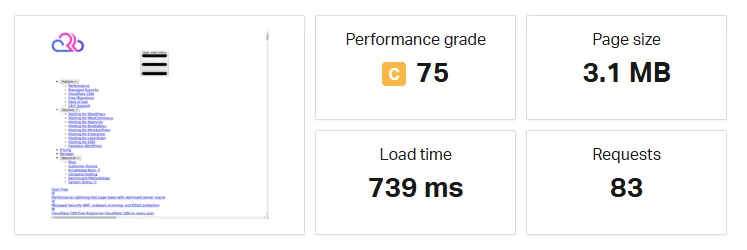
In my test, the website loaded in 739 ms, which is actually very fast (under 1 second). But the performance grade was C (75), which tells me there is still room for improvement.
The page size was 3.1 MB, and there were 83 requests, which is a bit high. From my personal experience, I’ve seen that heavy images and too many scripts can lower the score.
So even though the server is fast, the website itself needs some optimization. If you reduce the page size and requests, this can easily become an A-grade website.
Server Response Time
Server response time is one of the most critical performance factors. Rapyd Cloud optimizes this through efficient database query handling and real-time resource allocation. This reduces delays and improves overall site responsiveness.
Even under moderate load, response times remain stable. This is especially important for high-traffic websites where delays can directly impact conversions.
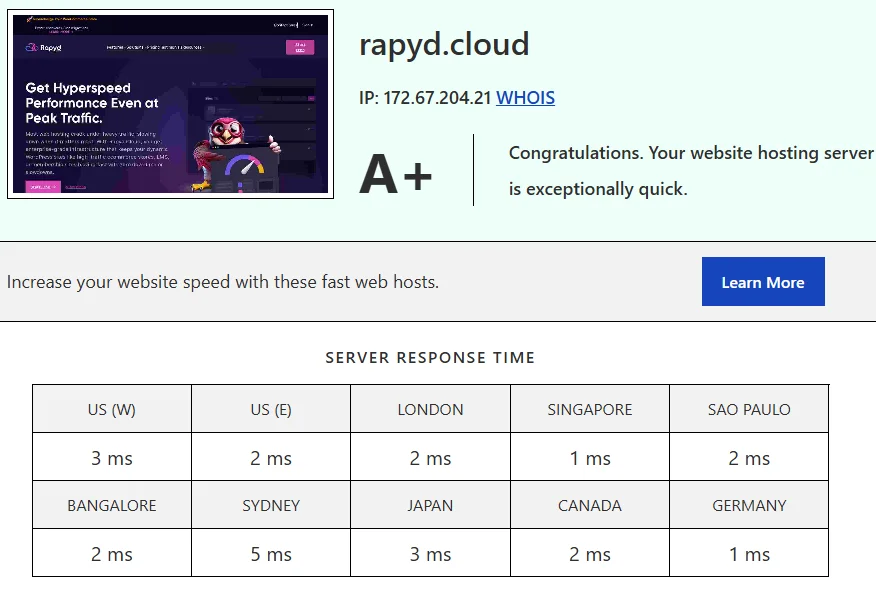
When I tested this hosting server’s response, I was honestly impressed by the results. It got an A+ grade, which means the server is extremely fast. I checked response times from different locations, and most of them were between 1 ms and 5 ms, which is very rare.
In my testing experience, many hosting providers slow down in some regions, but this one stayed fast everywhere. For me, this clearly shows that the server is powerful and well-optimized. If your audience is global, this kind of speed can make a big difference in user experience.
Uptime Monitoring
Uptime is another strong area for Rapyd Cloud. The platform maintains consistent availability with minimal downtime. This reliability is essential for businesses that depend on their website for revenue.
It also performs well during traffic spikes, maintaining stability without crashes. That makes it a dependable option for growing websites.
Security Built Into Every Plan
Security isn’t treated as an add-on here—it’s built into the core infrastructure. Rapyd Cloud includes multiple layers of protection designed to keep WordPress sites safe from common threats. This is especially important for e-commerce and membership platforms.
From proactive monitoring to advanced filtering, the platform aims to reduce risks without requiring manual intervention. Let’s break down the key components.
Cloudflare Enterprise CDN Integration
Rapyd Cloud integrates with Cloudflare’s enterprise-level CDN, improving both speed and security. This reduces latency and protects against malicious traffic at the network level.
It also helps with global content delivery, ensuring fast loading times for users regardless of location. That’s a major advantage for international websites.
Proactive Plugin Vulnerability Defense
Plugin vulnerabilities are a common issue in WordPress. Rapyd Cloud addresses this with proactive monitoring and patching systems. It can detect and respond to threats before they cause damage.
This reduces the need for constant manual checks, saving time while improving security.
Real-Time Malware Scanning
The platform includes continuous malware scanning to detect threats instantly. If suspicious activity is found, it can take action quickly to prevent further issues.
This kind of real-time protection is crucial for maintaining site integrity and user trust.
DDoS Protection, Bot Filtering, and SSL
Rapyd Cloud includes DDoS protection, bot filtering, and automatic SSL certificates. These features work together to block harmful traffic and secure data transmission.
For businesses handling sensitive data, this level of protection is essential rather than optional.
Features and Ease of Use
Rapyd Cloud offers a strong set of features designed for both beginners and advanced users. Instead of overwhelming you, it focuses on practical tools that improve performance and workflow.
Key Features:
- Managed WordPress hosting with cloud infrastructure
- Auto-scaling PHP workers for traffic spikes
- High-performance hosting optimized for dynamic websites
- Redis caching and object cache support
- Built-in CDN integration
- Real-time resource allocation
- Advanced caching for logged-in users
- Developer-friendly tools (SSH, WP-CLI, Git)
- Staging environment workflow
- Plugin-level performance monitoring
- Secure WordPress hosting environment
- DDoS protection and firewall
- Fast loading WordPress hosting stack
- WooCommerce optimization
- Hosting for LMS and membership sites
- Multi-site support for agencies
- Real-time analytics and monitoring
- Automatic backups and recovery
The interface is clean and easy to navigate. Even if you’re not technical, you can manage your site without confusion. At the same time, advanced users still get the control they need.
Pros and Cons
Pros:
- Excellent performance for dynamic WordPress sites
- Handles traffic spikes automatically
- Strong security features built-in
- Developer-friendly environment
- Great for WooCommerce and membership sites
- Reliable uptime and fast server response
- Advanced caching and optimization tools
Cons:
- Pricing may be higher than that of basic hosting providers
- Not ideal for very small or low-traffic websites
- Some advanced features may require learning
Rapyd Cloud Plans and Pricing

| Plan Name | Cost per Month | Allowed Sites | SSD Storage | Monthly Traffic Limit |
|---|---|---|---|---|
| Starter | $29/month | 1 Website | 10GB | Up to 25K visits |
| Business | $99/month | 3 Websites | 25GB | Up to 75K visits |
| Performance | $299/month | 20 Websites | 75GB | Up to 500K visits |
Pricing of Rapyd Cloud is positioned in the premium category, which reflects its performance-focused infrastructure. It’s not the cheapest option, but it targets users who need reliability and speed.
There’s typically a short free trial, allowing you to test the platform before committing. When compared to alternatives like WP Engine or Kinsta, it can be a competitive option depending on your needs. For serious websites, the value comes from performance and scalability rather than just cost.
Who Should Switch to Rapyd Cloud?
Rapyd Cloud is best suited for users who need more than basic hosting. If your site struggles with speed or traffic spikes, this platform can make a noticeable difference.
It’s particularly useful for agencies, WooCommerce store owners, LMS platforms, and membership sites. If you manage high-traffic websites or expect growth, it provides the infrastructure needed to scale smoothly.
How does Rapyd Cloud match up to the competition?
When compared to Kinsta and WP Engine, Rapyd Cloud stands out in scalability and dynamic performance. While those platforms are strong, they often rely more on fixed resources.
Rapyd Cloud’s ability to handle high concurrency and real-time scaling gives it an edge for demanding websites. However, for simpler use cases, competitors may still be sufficient.
Rapyd Cloud vs Kinsta
Kinsta is known for premium managed WordPress hosting with strong performance and Google Cloud infrastructure, but it mainly relies on fixed resource allocation. Rapyd Cloud, on the other hand, focuses more on real-time scaling and high concurrency performance, making it stronger for dynamic sites. If your site experiences sudden traffic spikes or heavy user activity, Rapyd Cloud can feel more flexible. However, Kinsta still wins in overall polish and ecosystem maturity.
Rapyd Cloud vs WP Engine
WP Engine is a veteran in managed WordPress hosting, offering stability, security, and solid developer tools, but it can feel less flexible under extreme traffic conditions. Rapyd Cloud differentiates itself with auto-scaling PHP workers and dynamic performance optimization for logged-in users and WooCommerce stores.
This makes it better suited for high-traffic or interactive websites. WP Engine remains a safe, enterprise-grade choice, but Rapyd Cloud is more performance-aggressive.
Rapyd Cloud vs Cloudways
Cloudways gives you more freedom with multiple cloud providers and flexible pricing, but it also requires more manual optimization and technical setup. Rapyd Cloud simplifies this by offering a more managed, performance-focused environment out of the box.
Its built-in caching, CDN integration, and real-time resource allocation reduce the need for tuning. Cloudways is better for control, while Rapyd Cloud is better for “set and scale” performance.
Rapyd Cloud vs Rocket.net
Rocket.net is heavily optimized around Cloudflare Enterprise and delivers extremely fast global performance with simplicity. Rapyd Cloud competes by focusing more on backend scalability, dynamic workloads, and high concurrency handling.
While Rocket.net excels in edge performance and simplicity, Rapyd Cloud is stronger for complex WordPress sites with heavy user interaction. Your choice depends on whether you prioritize edge speed or backend scalability.
Customer Support
Rapyd Cloud provides responsive and technical support that is focused on real hosting issues rather than generic replies. You typically get help through live chat or ticket-based support, and the team is knowledgeable about WordPress, performance tuning, and server-level problems. This is especially useful when dealing with scaling issues, plugin conflicts, or traffic spikes.
Compared to basic hosting providers, their support feels more hands-on and developer-oriented. However, response times may vary depending on plan level and the complexity of the issue. Overall, it’s a solid support system for users who run serious, high-performance WordPress websites.
Final Verdict: Is Rapyd Cloud Worth It?
After analyzing everything, the Rapyd Cloud Review shows that this platform is built for performance-driven users. It’s not trying to be the cheapest option—it’s focused on delivering speed, stability, and scalability.
If you run a serious WordPress site, especially one with dynamic content or high traffic, it’s absolutely worth considering. However, if you’re just starting, a simpler hosting provider might be enough.
FAQs
What is Rapyd Cloud best for?
It’s best for high-traffic WordPress sites, WooCommerce stores, and membership platforms.
Is Rapyd Cloud good for beginners?
Yes, but beginners may not need its advanced features.
Does Rapyd Cloud handle traffic spikes?
Yes, it uses auto-scaling to manage sudden traffic increases.
Is Rapyd Cloud secure?
Yes, it includes built-in security like malware scanning and DDoS protection.
How does it compare to WP Engine?
It offers better scalability but may have a learning curve.
Is there a free trial?
Yes, a short trial is usually available to test the platform.
Is Rapyd Cloud expensive?
It’s a premium option, but justified for high-performance needs.
Related

Alex Bryant is the founder of PvyEmpire.com and a WordPress specialist with over 4 years of hands-on experience in web hosting, performance optimization, and website management. He has extensively tested top hosting providers by setting up real websites and monitoring their speed, uptime, and reliability.
At PvyEmpire.com, Alex publishes honest, data-driven reviews, detailed guides, and verified coupons & deals. His goal is to help website owners choose the right hosting, improve performance, and grow their online presence with confidence—based on real testing, not promotions.