Private Cloud Hosting: Features, Benefits & How It Works
Many businesses reach a point where shared hosting no longer feels secure enough, but moving to a fully dedicated environment seems expensive and complicated.
If you’ve been wondering how to balance performance, security, and control without overspending, you’re not alone. That’s exactly why so many people start looking into Private Cloud Hosting.
In this guide, you’ll learn what Private Cloud Hosting is, how it works, and why it’s becoming a popular choice for growing businesses. We’ll break down the key benefits, important features, and things to consider before choosing a provider, so you can make a confident decision.
What is Private Cloud Hosting?
Private Cloud Hosting is a dedicated cloud environment built for a single organization instead of multiple users. It gives you more control, stronger security, and better performance compared to shared systems. Businesses often choose it when they need flexibility without sacrificing data protection.
In simple terms, Private Cloud Hosting is a setup where your infrastructure is isolated but still powered by cloud technology. It combines the scalability of cloud systems with the security of private infrastructure. This makes it a strong choice for companies handling sensitive or high-value data.
How Private Cloud Hosting Works
Private cloud systems run on virtualized infrastructure that is reserved for one business only. Instead of sharing servers with others, you get dedicated resources that can be scaled as needed. This setup improves speed, stability, and customization options.
A typical Private Cloud Hosting environment uses virtualization tools to divide physical servers into multiple controlled layers.
These layers are managed through a secure dashboard where admins can monitor performance, allocate resources, and control access. It feels like having your own cloud “data center” without managing all the physical hardware yourself.
Key Features of Private Cloud Hosting
One of the strongest advantages of private cloud systems is control. You can customize storage, processing power, and security settings based on your needs. This makes it suitable for businesses with specific compliance or performance requirements.
Security is another major feature. Data stays isolated, which reduces exposure to external threats. Many providers also offer encryption, firewalls, and monitoring tools to strengthen protection. These features make it ideal for industries that cannot risk data leaks or downtime.
- Dedicated infrastructure for a single organization
- High-level data security and isolation
- Full control over server configuration and resources
- Customizable storage, CPU, and memory allocation
- Scalable infrastructure for growing workloads
- Advanced firewall and intrusion protection systems
- End-to-end data encryption for secure communication
- High availability with built-in failover systems
- Automated backup and disaster recovery options
- 24/7 monitoring and system performance tracking
- Compliance support for industry regulations (like HIPAA, GDPR)
- Flexible deployment options (on-premise or hosted)
- Support for virtualization technologies
- Integration with hybrid and multi-cloud environments
- Dedicated IP addresses for improved reliability
- Optimized performance for high-traffic applications
- Resource isolation to prevent performance interference
- Custom security policies and access controls
- API and automation support for DevOps workflows
- SLA-backed uptime guarantees for reliability
Types of Private Cloud Hosting
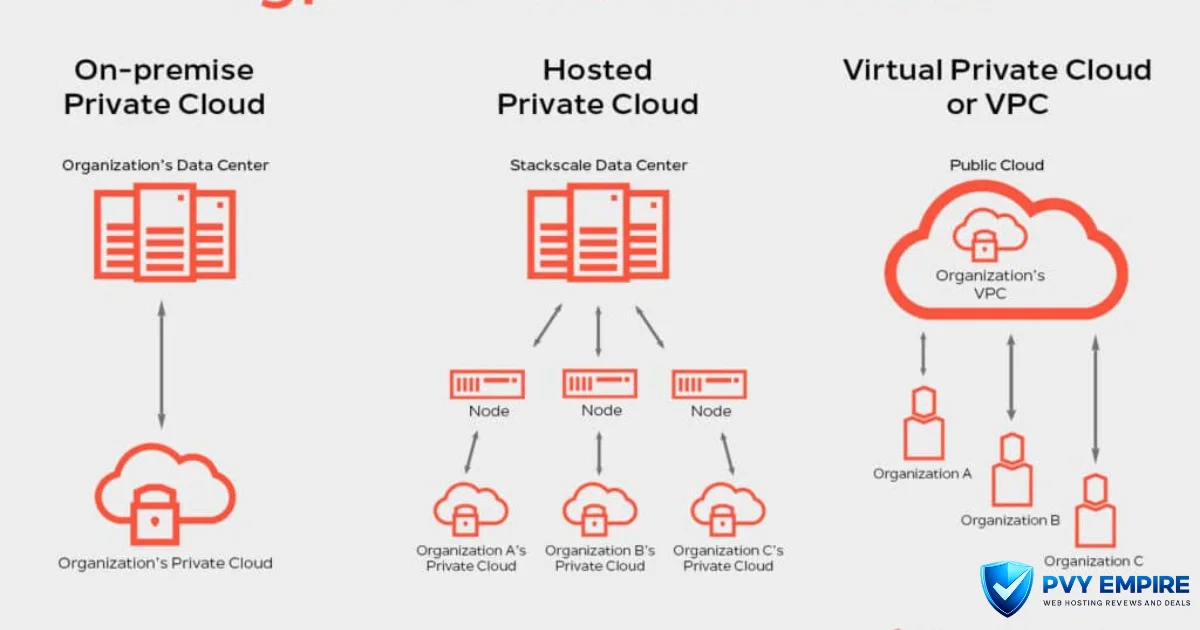
Private cloud solutions come in different models depending on how they are deployed and managed. Each type offers a different level of control and responsibility.
On-premises Private Cloud
This model is hosted within your own data center. Your company manages everything, from hardware to software. It offers maximum control but also requires higher technical expertise and maintenance effort.
Managed Private Cloud
In this setup, a hosting provider handles infrastructure management for you. You still get dedicated resources, but the provider takes care of updates, security, and monitoring. It is ideal for businesses that want performance without technical burden.
Virtual Private Cloud (VPC)
A Virtual Private Cloud (VPC) is a segmented environment within a public cloud platform. It provides isolation similar to a private setup but runs on shared cloud infrastructure. This makes it more cost-efficient while still offering strong security controls.
Benefits of Private Cloud Hosting
The biggest advantage of Private Cloud Hosting is performance consistency. Since resources are not shared, your applications run smoothly even during high traffic. This is especially useful for growing businesses that need reliability.
Another key benefit is security and compliance. With isolated infrastructure, you can meet strict regulatory standards more easily. Many organizations also prefer it because it reduces the risk of data breaches while offering full control over configurations.
- Enhanced data security with isolated infrastructure
- Better performance due to dedicated resources
- Full control over server settings and configurations
- Improved reliability with high uptime and stability
- Easier compliance with industry regulations
- Scalable resources that grow with your business needs
- Reduced risk of data breaches and external threats
- Custom security policies tailored to business requirements
- Faster application performance during high traffic
- Flexible deployment options (on-premise or hosted)
- Better disaster recovery and backup solutions
- Consistent performance without resource sharing issues
- Strong support for business-critical applications
- Cost efficiency in the long term for enterprises
- Seamless integration with existing IT systems
- Improved operational efficiency for IT teams
- Dedicated environment for sensitive workloads
- Better user experience for customers and employees
- Advanced monitoring and system management tools
- Greater flexibility compared to traditional hosting models
Use Cases of Private Cloud Hosting
Private cloud systems are widely used in industries where data protection is critical. Healthcare organizations use them to store patient records securely. Financial institutions rely on them for transaction processing and fraud protection.
E-commerce businesses also benefit during peak traffic periods. The scalability ensures websites stay online during sales events. Similarly, software companies use it for testing environments where performance and isolation are important.
Conclusion
Private cloud solutions are becoming a preferred choice for businesses that need balance between control and flexibility. They offer stronger performance, better security, and scalable infrastructure for modern workloads.
In today’s digital environment, choosing the right hosting model can directly impact growth and reliability. Private cloud gives you that stability while still keeping your systems flexible for future expansion.
FAQs
What is Private Cloud Hosting in simple words?
It is a dedicated cloud system used by one business only, offering better security and control than shared hosting.
How is private cloud different from public cloud?
Private cloud is exclusive to one organization, while public cloud is shared among multiple users.
Is private cloud expensive?
It can be more costly than shared hosting, but it delivers higher performance and security value.
Who should use private cloud hosting?
Businesses handling sensitive data, high traffic websites, or compliance-heavy industries benefit most.
Can private cloud be customized?
Yes, you can adjust resources, security settings, and configurations based on your needs.
Is private cloud secure?
Yes, it offers strong isolation, encryption, and monitoring features for better protection.
Does it support scalability?
Yes, resources can be scaled up or down depending on workload demands.

Alex Bryant is the founder of PvyEmpire.com and a WordPress specialist with over 4 years of hands-on experience in web hosting, performance optimization, and website management. He has extensively tested top hosting providers by setting up real websites and monitoring their speed, uptime, and reliability.
At PvyEmpire.com, Alex publishes honest, data-driven reviews, detailed guides, and verified coupons & deals. His goal is to help website owners choose the right hosting, improve performance, and grow their online presence with confidence—based on real testing, not promotions.