Bluehost vs Kinsta: The Ultimate Hosting Showdown
Picking a web host always sounds simple, until you actually sit down and try to do it. Suddenly you’re staring at a dozen browser tabs, reading reviews that all seem to contradict each other, and wondering why something as basic as “where does my website live” feels so complicated.
If you’ve landed on the classic bluehost vs kinsta debate, you’re probably torn between one option that’s affordable and familiar, and another that promises speed and premium performance but costs more.
That’s exactly what we’re going to sort out here. Instead of throwing jargon at you, we’ll walk through how each platform actually performs, what kind of support you get, and where your money really goes with each one.
Think of this as the conversation you’d have with a friend who’s already tested both and is happy to save you the trial and error.
By the end, you’ll have a clear sense of which host fits your budget, your technical comfort level, and your site’s actual needs, so you can make the choice with confidence instead of second-guessing yourself later.

Bluehost vs Kinsta: What’s the Difference?
Bluehost and Kinsta aren’t really competing in the same weight class. Bluehost is a generalist hosting provider that leans on shared server resources to keep prices low, while Kinsta is a WordPress-only host built on Google Cloud’s premium tier infrastructure.
In other words, one is built to be cheap and flexible, and the other is built to be fast and specialized.

That difference shapes almost everything else in this comparison. Bluehost spreads your site across shared resources with other customers, which keeps costs down but can mean slower load times when traffic spikes.

Kinsta, on the other hand, gives every site its own isolated container with dedicated resources, so your site’s performance isn’t tied to what your “neighbors” are doing.
Bluehost Overview
Bluehost launched in 2003 out of Jacksonville, Florida, and has grown into one of the largest web hosting providers on the internet. It’s officially recommended by WordPress.org, which is a big part of why beginners gravitate toward it.
What makes Bluehost appealing is its low entry price and broad feature set. You get shared hosting, WordPress hosting, VPS, cloud, and dedicated servers all under one roof, plus a free domain, automatic WordPress installs, and a familiar cPanel-style dashboard.
It’s less about doing one thing perfectly and more about giving you everything you need to launch a site without breaking the bank.
Kinsta Overview
Kinsta was founded in 2013 in Los Angeles, and it built its entire reputation around one thing: managed WordPress hosting done well. Instead of splitting a server across hundreds of accounts, Kinsta runs every website in its own isolated environment on Google Cloud’s premium infrastructure.
That focus shows up in the details. Kinsta uses a custom-built dashboard called MyKinsta instead of the generic cPanel most hosts rely on, and its support staff are trained specifically in WordPress rather than general hosting troubleshooting.
It’s the kind of host that agencies and high-traffic WordPress sites pick when uptime and page load times actually affect the bottom line.
Bluehost vs Kinsta Plans and Pricing
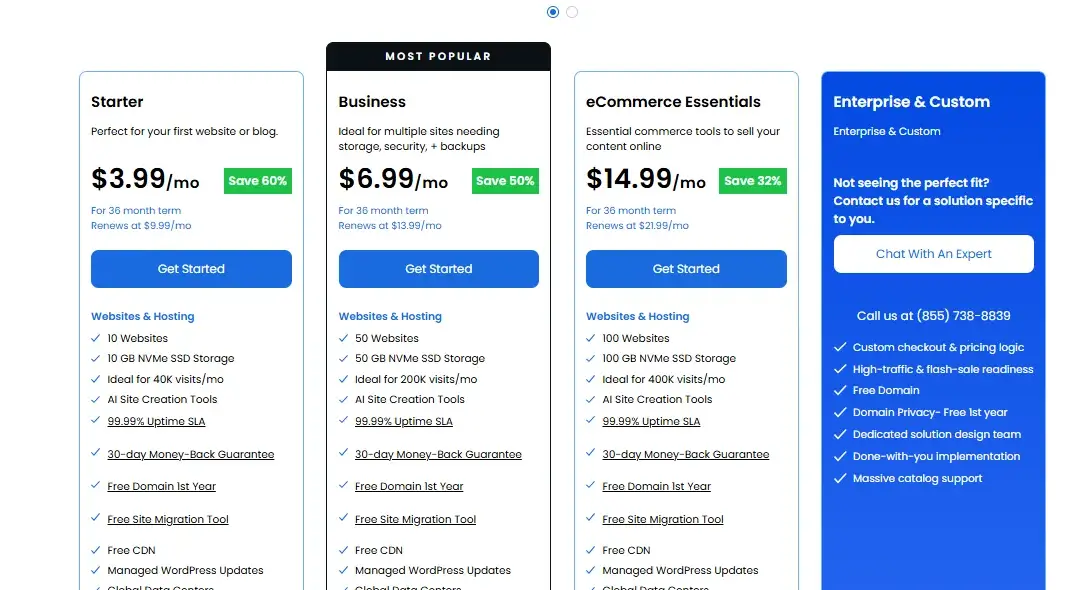
Pricing is where the two platforms diverge the most, and honestly, where most people make their decision. Bluehost’s shared plans start under $3.99 a month, while Kinsta’s cheapest managed WordPress plan runs $35 a month.
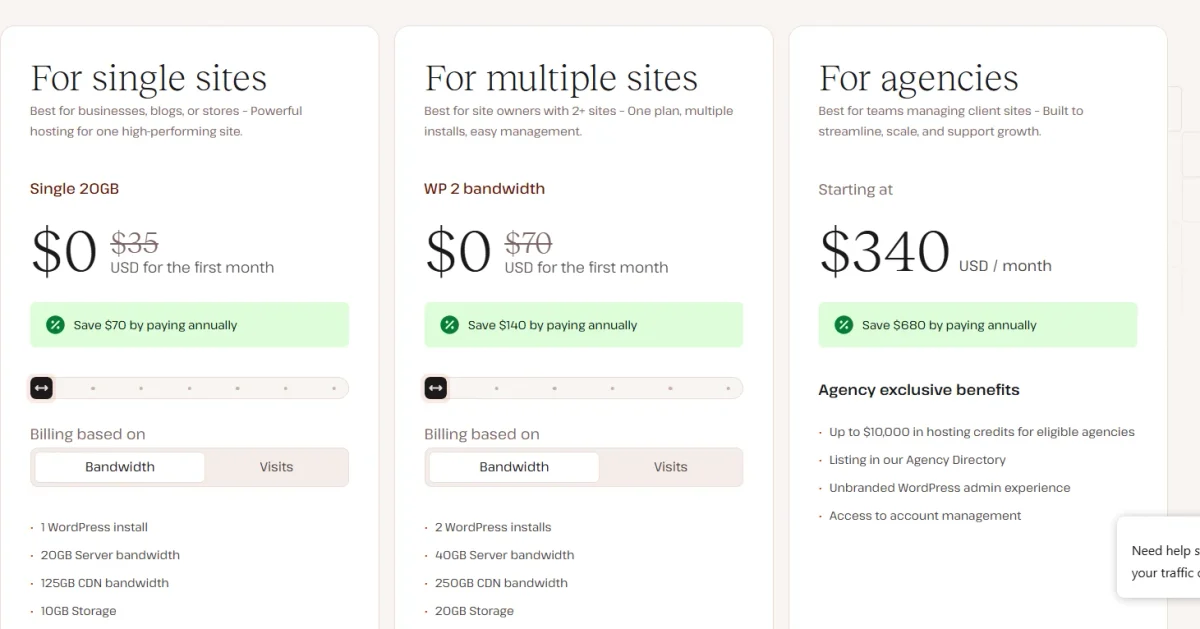
That’s not a small gap, and it comes down to what you’re actually paying for: shared server space versus dedicated cloud resources.
Bluehost Hosting Plans and Costs
| Plan | Intro Price | Renewal Price | Websites | Storage | Best For |
|---|---|---|---|---|---|
| Basic | $3.99/mo | $9.99/mo | 1 site | 10 GB NVMe SSD | New blogs, personal sites |
| Choice Plus | $6.99/mo | $13.99/mo | 50 sites | 50 GB NVMe SSD | Small businesses |
| Online Store | $14.99/mo | $21.99– | 100 sites | 100 GB NVMe SSD | eCommerce with WooCommerce |
| Pro | $19.99/mo | $23.99– | Unlimited sites | Unlimited NVMe SSD | Freelancers, agencies |
These figures are based on the 36-month billing term, which is how Bluehost advertises its lowest headline rates.
That’s worth flagging clearly: renewal prices typically jump 100–150% once your initial term ends, so a $3.99/mo plan can renew closer to $9.99/mo.
If you’re budgeting long-term, plan around the renewal number, not the sign-up price.
Kinsta Hosting Plans and Costs
| Plan | Monthly Price | WordPress Sites | Monthly Visits | Storage | Best For |
|---|---|---|---|---|---|
| Starter | $35/mo ($30/mo annual) | 1 site | 25,000–35,000 visits | 10 GB SSD | Single-site blogs, small businesses |
| Pro | $70/mo | 2 sites | 60,000 visits | 20 GB SSD | Growing sites, freelancers |
| Business 1 | $115/mo | 5 sites | 150,000 visits | 30 GB SSD | Small agencies |
| Agency 40 | $340/mo | 40 sites | 750,000 visits | 100 GB SSD | Agencies managing client portfolios |
Kinsta prices based on visits, storage, and PHP workers rather than locking features behind tiers, so every plan runs on the same premium Google Cloud infrastructure.
Annual billing knocks two months off the price, and Kinsta occasionally offers a first month free on entry plans like the Starter tier.
Bluehost vs Kinsta Features and Hosting Types
Beyond pricing, the two hosts also differ in how many types of hosting they offer and how deep their WordPress-specific tools go. Bluehost casts a wide net; Kinsta goes narrow and deep.
Key Features Included With Bluehost
- Free domain name for the first year
- Free SSL certificate on every plan
- Automatic WordPress installs and updates
- AI website builder and WonderSuite design tools
- Unlimited websites, storage, and traffic on higher-tier plans
- cPanel-based control panel most hosting veterans already know
- Support for shared, WordPress, VPS, cloud, and dedicated hosting
Key Features Included With Kinsta
- Bluehost vs Kinsta comparisons almost always highlight Kinsta’s dedicated PHP workers, which prevent one traffic spike from slowing every site on the account
- MyKinsta dashboard built specifically for WordPress management
- DevKinsta local development and staging environment
- Free CDN with edge caching across 30+ global data centers
- Free Yoast SEO Premium and Jetpack bundled in
- Automatic daily backups plus on-demand backups
- Cloudflare Enterprise DDoS protection on every plan
Supported Software and Hosting Options
| Category | Bluehost | Kinsta |
|---|---|---|
| CMS Support | WordPress, WooCommerce, Joomla, Drupal, Magento | WordPress, WooCommerce only |
| Control Panel | cPanel | MyKinsta (proprietary) |
| Hosting Types | Shared, WordPress, VPS, Cloud, Dedicated | Managed WordPress only |
| Developer Tools | SSH, WP-CLI, Git (on select plans) | SSH, WP-CLI, Git, staging, DevKinsta |
| Databases | MySQL, MariaDB | MySQL |
If you need a host that can also run a Django app, a Laravel project, or a non-WordPress CMS, Bluehost gives you that flexibility. Kinsta simply doesn’t try to be a generalist, and honestly, that’s by design.
Performance and Speed Comparison
Kinsta wins on raw performance, and it’s not particularly close. Independent benchmarks show Kinsta consistently loading pages between 0.8 and 1.6 seconds thanks to its container-based Google Cloud infrastructure, while Bluehost’s shared hosting tends to run slower under sustained traffic because resources are split across many accounts on the same server.
Website Speed and Server Response Time
Server response time comes down to how many other sites you’re sharing resources with. On Bluehost’s shared plans, a traffic spike on another site hosted on the same server can genuinely slow your own pages down.
Kinsta avoids this entirely because every WordPress installation runs in its own isolated container with dedicated PHP workers, so your site’s speed isn’t at the mercy of someone else’s Black Friday sale.
Uptime and Reliability
| Host | Uptime Guarantee | SLA Type |
|---|---|---|
| Bluehost | 99.99% uptime SLA | Standard shared hosting SLA |
| Kinsta | 99.9% standard, up to 100% on Agency plans | Enterprise-backed SLA with compensation |
Both hosts publish strong uptime numbers, but Kinsta’s agency-tier plans go a step further by offering guaranteed compensation if uptime commitments aren’t met.
In practice, that means Kinsta treats downtime as a service failure worth crediting, not just a number on a marketing page.
Data Center Locations and Global Coverage
Bluehost operates from a smaller number of physical data centers concentrated mainly in the United States, which is fine if most of your traffic is domestic but less ideal for a global audience.
Kinsta, by contrast, runs on Google Cloud’s network and gives customers a choice of 30+ data center regions spanning North America, Europe, Asia, Oceania, South America, and Africa.
For a site targeting readers or customers across multiple continents, that data center spread genuinely matters.
Choosing a Kinsta data center close to your primary audience can shave real milliseconds off load times, and in ecommerce, milliseconds translate into conversions.
Bluehost vs Kinsta Security
Security is one area where both hosts take the basics seriously, but Kinsta layers in more automation and monitoring by default. Bluehost covers you with free SSL and optional add-ons, while Kinsta bakes enterprise-grade protection into every plan without upcharging for it.
Security Features and Protection
- Bluehost: Free SSL certificate, SiteLock partnership for malware scanning (paid add-on), CodeGuard automated backups (paid on lower tiers, free on Choice Plus and Pro), Cloudflare integration
- Kinsta: Free SSL, Cloudflare Enterprise DDoS protection included on every plan, real-time malware and hack scanning, automatic daily backups with no extra charge, proactive uptime monitoring with instant alerts, enterprise-level firewall
The practical difference is that Bluehost’s stronger security tools, like SiteLock and CodeGuard, often live behind an extra monthly fee unless you’re on a higher-tier plan. Kinsta includes comparable protection across every plan tier, so you’re not nickel-and-dimed for basic peace of mind.
Developer Tools and WordPress Management
If you’re a developer or you work with one, Kinsta is built with you in mind. Bluehost gives you the tools too, but they feel bolted on rather than central to the experience.
Developer Features and Tools
- SSH and SFTP access (both hosts)
- Git version control integration
- WP-CLI command-line management
- Staging environments — Bluehost offers this on select plans, Kinsta includes it on every plan
- Multiple PHP versions
- DevKinsta, Kinsta’s free local development app for building and testing sites offline before pushing live
WordPress Management Experience
Managing a WordPress site through MyKinsta feels noticeably more purpose-built than doing the same through Bluehost’s cPanel.
Kinsta’s dashboard shows real-time analytics, PHP worker usage, and one-click staging pushes, all without leaving the interface.
Bluehost’s cPanel is familiar and functional, but it wasn’t designed exclusively around WordPress, so some tasks take a few extra clicks to reach.
Customer Support and User Experience
Support quality is one of the more consistent gaps between these two hosts across independent surveys.
Kinsta’s WordPress-only focus means its support agents troubleshoot WordPress issues all day, every day, while Bluehost’s team handles a much broader range of hosting types.
Support Quality and Availability
| Support Channel | Bluehost | Kinsta |
|---|---|---|
| Live Chat | Yes, 24/7 | Yes, 24/7 |
| Phone Support | Yes | Limited/priority plans only |
| Email/Ticket Support | Yes | Yes |
| Knowledge Base | Yes | Yes |
| WordPress-Specific Training | General hosting support | Dedicated WordPress experts |
Bluehost still offers phone support, which some users genuinely prefer for urgent issues.
Kinsta leans almost entirely on live chat and tickets, but the tradeoff is that the person answering usually has deep, WordPress-specific expertise rather than general hosting knowledge.
Customer Satisfaction
Survey data from CodeinWP’s WordPress hosting study, which polled around 800 WordPress users, found Kinsta scoring 4.9 out of 5 on WordPress-specific support versus Bluehost’s 3.2–3.4 range (source).
Trustpilot ratings tell a similar story, with Kinsta averaging around 4.8 out of 5 compared to Bluehost’s roughly 3.3 out of 5 across hundreds of reviews.
That gap isn’t just a marketing talking point — it shows up consistently across independent review platforms. If dependable, knowledgeable support is a priority for you, especially when something breaks at 2 a.m., Kinsta has the stronger track record.
Bluehost vs Kinsta: Key Differences at a Glance
| Feature | Bluehost | Kinsta |
|---|---|---|
| Starting Price | $3.99/mo | $35/mo |
| Hosting Type | Shared, VPS, Cloud, Dedicated, WordPress | Managed WordPress only |
| Uptime Guarantee | 99.99% | 99.9%–100% (agency tier) |
| Data Centers | Handful, mostly U.S.-based | 30+ global regions via Google Cloud |
| Control Panel | cPanel | MyKinsta (proprietary) |
| Free CDN | Add-on/limited | Included on all plans |
| Staging Sites | Select plans | All plans |
| Support Rating | 3.2–3.4/5 (WordPress-specific) | 4.8–4.9/5 |
| Best For | Beginners, budget sites, non-WordPress projects | High-traffic WordPress sites, agencies |
Bluehost vs Kinsta: Which Host Is Better for You?
There isn’t a universal “better” host here, only a better fit for your specific situation. Your budget, your traffic level, and how much you value speed versus savings should drive the decision more than any single review score.
Which Host Is Better for Beginners?
Bluehost is the better starting point for most beginners, mainly because of price and simplicity.
At under $3.99 a month, it’s an easy way to get a first website online without committing serious money, and its one-click WordPress installer removes most of the technical guesswork.
Which Host Is Better for High-Traffic WordPress Sites?
Kinsta is the clear choice once your site starts pulling in real traffic. Its dedicated resources and Google Cloud infrastructure mean performance doesn’t degrade as visitor numbers climb, which is exactly the scenario where shared hosting on Bluehost tends to struggle.
Which Host Offers Better Value for Money?
It genuinely depends on how you define value. Bluehost offers more raw resources — unlimited storage, unlimited sites, unlimited traffic — for a lower monthly cost, which is hard to beat for budget-conscious users.
Kinsta charges more but bundles in premium tools like Yoast SEO Premium, free staging, and enterprise security that would otherwise cost extra elsewhere, so the per-feature value narrows the price gap more than it first appears.
Bluehost vs Kinsta: Pros and Cons
Bluehost Pros
- Extremely low starting price
- Unlimited websites, storage, and traffic on higher plans
- Supports multiple hosting types beyond WordPress
- 24/7 phone, chat, and email support
- Officially recommended by WordPress.org
Bluehost Cons
- Renewal prices jump significantly after the intro term
- Shared resources can slow performance under traffic spikes
Kinsta Pros
- Dedicated resources and container-based isolation per site
- 30+ global data centers on Google Cloud
- Free CDN, staging, and premium plugins bundled in
- Strong customer satisfaction and WordPress-specific support
- Enterprise-grade security included by default
Kinsta Cons
- Significantly higher starting price
- WordPress-only, so it won’t work for non-WordPress projects
Is Kinsta Worth the Higher Price?
For most high-traffic or revenue-generating WordPress sites, yes, Kinsta’s higher price is worth it.
The combination of dedicated resources, a global CDN, and included premium tools like Yoast SEO Premium adds up to real savings compared to buying those pieces separately on a cheaper host.
Where it stops making sense is on low-traffic personal blogs or hobby sites that don’t generate revenue. If your site pulls a few hundred visitors a month, paying $35/mo for infrastructure built to handle enterprise traffic is overkill.
The math flips once your site starts converting visitors into leads or sales, because even small speed improvements can measurably boost conversions and SEO rankings.
Can You Migrate From Bluehost to Kinsta Easily?
Yes, migrating from Bluehost to Kinsta is straightforward, and Kinsta’s team handles most of the technical work for you at no extra cost. Here’s how the process typically goes:
- Sign up for a Kinsta plan that matches your current site’s traffic and storage needs.
- Request a free migration through Kinsta’s dashboard or support team — this is included on every plan.
- Provide your Bluehost site’s login credentials or grant temporary access so Kinsta’s migration team can copy your files and database.
- Let Kinsta’s team complete the migration, which usually takes anywhere from a few hours to a couple of days depending on site size.
- Test your site on Kinsta’s staging environment before pointing your domain there, checking pages, forms, and plugins for issues.
- Update your domain’s DNS settings to point to Kinsta once you’ve confirmed everything works correctly.
- Cancel your Bluehost plan only after your site has been live and stable on Kinsta for a few days.
The main thing to watch for is DNS propagation, which can take anywhere from a few minutes to 48 hours. Keeping both hosting accounts active during that window prevents any downtime for visitors.
Conclusion
At the end of the day, the bluehost vs kinsta choice really comes down to where your website is in its growth journey.
Bluehost works well for tight budgets and simple, low-traffic projects, while Kinsta earns its higher price tag through dedicated resources, faster load times, and support that actually specializes in WordPress.
Neither host is objectively “wrong” — they’re built for different goals. Take an honest look at your traffic, your budget, and how much downtime or slow loading would actually cost you, and the right choice tends to become obvious pretty quickly.
FAQs
Is Bluehost or Kinsta cheaper?
Bluehost is significantly cheaper to start, with shared plans from around $3.99/mo compared to Kinsta’s $35/mo entry price. However, Bluehost’s renewal rates climb sharply after the first term.
Which host performs better, Bluehost or Kinsta?
Kinsta performs better in almost every independent benchmark, loading pages in 0.8–1.6 seconds thanks to dedicated Google Cloud resources, while Bluehost’s shared hosting can slow under heavy traffic.
Can I host a non-WordPress site on Kinsta?
No, Kinsta is built exclusively for WordPress and WooCommerce sites. If you need to host Joomla, Drupal, or a custom application, Bluehost is the better fit.
Does Kinsta offer a money-back guarantee?
Yes, Kinsta offers a 30-day money-back guarantee on most plans, giving you time to test performance before committing long-term.
Is Bluehost good for beginners?
Yes, Bluehost’s low pricing, one-click WordPress installs, and familiar cPanel interface make it one of the easier hosts for first-time website owners.
How does support compare between the two hosts?
Kinsta consistently scores higher in WordPress-specific support surveys, averaging around 4.8–4.9 out of 5, compared to Bluehost’s 3.2–3.4 range, largely because Kinsta’s team focuses exclusively on WordPress.
Is it hard to migrate from Bluehost to Kinsta?
No, Kinsta provides free, expert-assisted migrations on every plan, and the process typically takes a few hours to a couple of days depending on your site’s size.

Alex Bryant is the founder of PvyEmpire.com and a WordPress specialist with over 4 years of hands-on experience in web hosting, performance optimization, and website management. He has extensively tested top hosting providers by setting up real websites and monitoring their speed, uptime, and reliability.
At PvyEmpire.com, Alex publishes honest, data-driven reviews, detailed guides, and verified coupons & deals. His goal is to help website owners choose the right hosting, improve performance, and grow their online presence with confidence—based on real testing, not promotions.